
Jalan Raja Muda Musa
KAMPUNG BARU

Anuar Ibrahim in a Political Rally in 1998
Extracted from https://lh6.googleusercontent.com/-rb1wVLNmo6c/UELGVlCJeEI/AAAAAAAAPUo/Lr1Y3egFQDk/s640/blogger-image--1314705654.jpg
HISTORICAL BACKGROUND
From its dominant skyline to the bustling city streets, Malaysia’s capital, Kuala Lumpur indicates a dynamic modern Asian city.
As a developing metropolis, the city experiences widespread development but in its shadows, the country’s past remains preserved. The co-existence between these old and new elements illustrates Kuala Lumpur’s past and present.
Situated around the outskirts of the city centre is the Kampung Baru neighbourhood. Known for being one of the very few real kampungs left in the city of Kuala Lumpur, Kampung Baru’s narrow streets and nostalgic culture and architecture makes one reminisce the origins of Kuala Lumpur’s cultural heritage. About 20 year ago, Kuala Lumpur was a low rise city with buildings that were no more than a few storeys high. Kampong Bharu is the right place to be to see Kuala Lumpur’s past. Kampung Baru was established in 1900 as a township for the Malays which sports a population of approximately 35 000.
Kampung Baru is made up of 378.93 acres of land, the bulk of which is under Malay reserve land. It is estimated that there are 4,300 lot owners in Kampung Baru, spread across seven villages.
Kampung Bharu has a long illustrious history as part of the Government’s efforts to promote Malay settlement in the capital city. Set aside as a Malay Agriculture Settlement reserve on Jan 12, 1900, it is one of the last remaining neighbourhoods in the city with distinctive Malay traditional houses and way of life.
Located in the shadows of the Petronas Twin Towers, it is an anomaly of a traditional and largely undeveloped residential enclave surrounded by gleaming high-rise office and residential buildings.
A drive around the settlement shows mostly traditional Malay houses and low-rise shop houses and apartments. The roads are narrow and many of the houses indicate a traditional Malay past.
Architecture along the streets of Jalan Raja Muda Musa in Kampung Bharu comprises of wooden traditional Malay houses built on stilts. As the city develops, a fusion of contemporary and traditional flavours is injected into the architecture within this viscinity. These houses feature a unique traditional Malay style such as the Colonial-Malay hybrid style and Limas style.
Beyond the streets, people are reminded of the urban life with a view of the city skyline that resides in the background of this nostalgic neighbourhood.
Few of the many significant events that have taken place along the street of Jalan Raja Muda Musa include the May 13 1969 racial riots where there was a dispute between the Malay and Chinese ethnic groups. Kampung Bharu was an area that was situated in the heart of the racial riots when it happened.
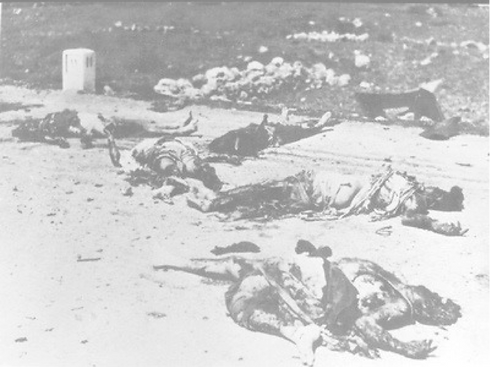
Racial Riot Massacre in 1969
Extracted from http://kualalumpurpost.net/wp-content/uploads/2012/07/may13.jpeg